Author Archives: 01austest

drainage problems at home
20
Nov
2021

On frequent occasions, homes across Melbourne call on plumbing experts to deal with a wide range of drain problems. Some of these problems occur more often than others. In this article, we will present some of the more common drain problems in homes and suggest solutions to them.

Common Water Leaks

From bathroom and kitchen leaks to burst pipes and hidden leaking slabs, water leaks happen to be a very common drain problem for homeowners in Melbourne. Water leaks can occur in various locations on a property, and some may be hidden and hard to find.

Apart from the obvious burst pipes and leaks from simple bathroom fittings, water leaks also occur in walls and under the ground, including fire service and irrigation pipelines. These may be hard to detect, but various methods, including thermal imaging, CCTV camera inspections, moisture mapping, smoke testing and acoustic leak detection, can be used to find hidden leaks.

If not detected early, water leaks can cause severe damage around your property with costly repair implications. If you suspect your property has a leak, you should immediately contact expert leak detection services like that offered by Austest. They have experienced water leak detection specialists who can assist with non-invasive tools in locating and fixing any hidden leaks.

Blocked drains

Blockages within the household pipe network is a major cause of drain problems in homes. If not fixed quickly, it can escalate into a property-wide problem that may be expensive to resolve. The following are some common causes of blockages.

Tree roots

The roots of large trees commonly cause blocked drains. This usually occurs where such trees are located near or on a property. The tree’s root system can rip through a crack in a nearby drain pipe, causing blockage of the pipe. A drain camera inspection can identify a drainage problem by locating and identifying the location of the blockage. The drain can then be excavated to carry out repairs on the damaged pipe before it is relayed. Minor breaches may be fixed by internally relining the pipe.

Hair

Hair often gets washed down the drain. Accumulation of hair, especially when mixed with conditioners and shampoos, can cause blockage if the build-up is sufficient to create slurry at the bottom of the drain. A drain cleaner can be used to dissolve the slurry to clear the shower drain. As a preventative measure, it is best to retrieve and bin hair strands while in the shower. A more practical solution would be to install a shower hair strainer on the floor gate.

Wipes and solid foreign objects

Some paper products are not normally flushable unless otherwise indicated by the manufacturer. It is advisable not to flush them because they absorb water and form bulky masses, which can cause blockage in the drainage system. Sanitary products like pads and tampons should be disposed of in a bin, not flushed down the toilet.

Solid foreign objects like toys can also cause drain blockage if they are tossed in the toilet (as kids often do). A plunger can help dislodge whatever is responsible for the blockage if the toilet won’t flush. If that fails, a powerful, high-pressure machine can be used.

Food and fats

Scrapings of food and fats from the kitchen sink are notorious for causing sink blockage. That’s because decomposing food tends to build up on the internal walls of the pipes until they eventually block the pipe. Try to break up the fat by pouring a mix of hot water and dishwashing liquid down the sink drain. If this fails, you can try vinegar and baking soda. Make sure you scrape plates and pots clean before washing them. Food and fat scrapings should be binned, not washed down the drain.

Slab heave

Slab heave occurs when there is uneven movement of a house footing and slab. This is caused by saturation with moisture or drying of the soils. Slab heave is quite common in highly reactive soils, which can be found in the Western suburbs of Melbourne and the inner-city areas. The soil becomes saturated if the sewer or stormwater pipes are broken. Clay soil absorbs moisture from the excess amount of water in the ground, leading to slab heave.

The first thing to do is find out if there are any leaks in the drainage around the property. The positions of the drains must be accurately located. If any broken pipes are detected, they must be repaired to help relieve the stress in the soil that’s causing the heave.

Final thoughts

Water leaks, blocked drains and slab heave are common drain problems in Melbourne homes. Locating and fixing them can prevent costly property damage. So, call in the experts early. With nearly 30 years of industry experience, AusTest Pipeline Solutions will deploy state-of-the-art tools such as thermal and acoustic equipment to find leaks, blocked drains or broken pipes without damaging your property. Call them today on 1800 532 533 if you have any questions or to request a quote.

leak detection technology benefit you
15
Oct
2021

Nobody wants leaks: they make a mess, damage your property, and put your family at risk. That said, many homeowners choose to trust industry professionals who are experts in leak detection to help them fix problems in their plumbing.

Below, we talk about some of the advantages of hiring a leak detector and why leak detection technology equipment can benefit you.

It saves you time

You can save precious time when you leave leak detection in the hands of professionals.

How?

Well, these individuals are trained to take on these tasks and carry them out on a daily basis, or at least whenever they are called to help fix leaks.

Some plumbers work specifically on residential houses, in both the city and in the suburbs, while others are trained for detecting leaks on commercial buildings.

Because they know the ins and outs of plumbing, they can finish a plumbing problem very quickly compared to someone with no idea what they’re faced with.

In addition, these plumbers are equipped with the latest leak detection technologies that can help them put a finger on where the problem in your piping could be.

Tools like thermal scanners and acoustic equipment can help them locate leaks with accuracy, cutting the time spent searching for tell-tale signs because they can easily find exactly where the leak is coming from.

This brings us to the next advantage of calling in a professional leak detector and allowing them to locate a leak successfully.

It saves you money

While others would argue that hiring a plumber who uses state-of-the-art gadgets is a waste of money, some think otherwise.

Why?

That’s because the traditional means of detecting leaks is to search for clues — both visible and audible. We’re talking about wet areas, damp spots, the presence of mold and mildew, peeling of paint and wallpaper, as well as the sound of dripping water and bad odour.

Looking out for these signs will help the traditional plumber narrow down the search where they will start to locate the leak.

In some cases, these signs lead them only to nearby areas where they would have to dig deeper—both literally and figuratively—to find the break in the pipe.

This means that they would have to break more walls (if the leak is behind your wall) or bore more holes on the floor (if you have a slab leak) which leads to unnecessary damage.

Not only does this mean you will have to pay more money to have the damaged areas repaired but this can also compromise the overall structural integrity of your home.

On the other hand, professionals who have leak detection equipment and are trained to use leak detection technologies can find exactly where the leak is coming from. This means there will be less damage to your property and should fixing the leak require the plumbers to break your walls or floors, it wouldn’t be enough to compromise the integrity of your property.

You get lasting results

Another benefit of hiring a leak detection expert is that they offer lasting results. Your plumber will not only locate the damaged pipe quickly and efficiently but also provide a lasting solution to your problem.

Thanks to the specialised equipment they use to detect leaks, they can spot not just the leak you called them to fix but also those that are hidden from plain sight.

As an example, a thermal camera lets them “see” moisture on the walls, the ceiling, and on the floors which allows them to locate other leaks or areas where a leak may occur in the future.

By doing so, they can prevent leaks from happening as they can apply solutions or refer you to a professional that can offer services that can repair the problem related to leaks.

Moreover, companies that have an established name in the industry will not risk putting their brand in jeopardy and will do their best to ensure that the fix they provide you will be satisfactory. They will do their best to uphold their promise to their customers and maintain a high standard in terms of quality and reliability.

You can expect quality workmanship, especially if you hire a trusted name in the plumbing industry.

Final words

So, there you have it. Some of the most compelling reasons why the latest technology in detecting leaks can help you and benefit you.

From fixing leaks to protecting property from water damage, hiring an expert in the field of plumbing, and detecting leaks in your pipe can be an advantage as you can get your whole property inspected using the latest technology in detecting water leaks.

burst water pipe at home
08
Sep
2021

Fixing a leak is hard enough, but fixing a burst pipe could prove to be more challenging. That’s why many homeowners opt to bring in professional leak detectors when dealing with water leaks as daunting as a burst water pipe.

If you’re searching the web on what to do when your water pipe gets damaged, then you’re in the right place. It’s no coincidence that Google brought you to this page because today, we will break down the steps that you need to take in the event of a water pipe burst.

Now of course, you can always call in the specialists if you’re not confident with your plumbing skills or if you have no idea on how to fix a broken water pipe, but if you plan to take on a DIY approach, then this article is for you. So, let’s begin.

Do You Have A Burst Water Pipe?

1. Shut the outlets

Remember, it’s one of the first things you should do in the event of any major water leak. Shut the outlets.

Your house may be designed to have several levers or a master switch that controls the flow of water from the main pipe to your home. It’s often located near the water meter, but make sure to check your home’s piping design to find out where the outlet switch is.

Once you find out, turn the water off. This will stop the pressure coming from the main pipes and will effectively cut the water preventing it from gushing out of the pipe to your home. If you have electronic appliances near the burst pipe, cutting the water will not only save you from excessive water bills but it can also save your appliances from water damage.

When finished, you’re ready for the next step.

2. Locate the damaged pipe

Not all burst pipes are in plain sight, sometimes they can be well hidden behind walls and much worse — under the concrete floor.

To locate water leaks behind walls, look for wet patches. If water seeps out of the pipes, you will find noticeable marks from warped wallpapers, bubbles in the paint, and even cracks on the walls. You should also watch out for moulds as they develop in wet and damp areas.

You can also do the same for leaks under the concrete flooring. The usual suspects like wet areas and stains on the floor are just some of the things you would want to look out for. And because water can stay stagnant longer when on the floor, they typically emanate a foul-smelling odour, so make sure to mark places with a foul smell.

3. Repair the pipe

Now that you’ve located the damaged pipe, you can come up with a feasible solution to fix the issue at hand.

For small damages, you can patch the break with a sealant. On the other hand, more significant damage might require pipe replacement. Make sure to use plumbers putty on the joints where the pipe has been repaired to avoid further leaks.

If you’re feeling a little technical, you can re-route the pipe if the damage was caused by a break in the structure of your home.

Otherwise, you should call in the leak detection experts to have them handle large-scale repairs as attempting to do it yourself with very little knowledge can sometimes lead to more expensive repairs than paying industry experts for the cost of a single project.

4. Test the pipe

When you’re finished with the repair, and if you’re confident that you’ve fixed the damage — after letting the sealant and bonding agent cure and rest of course — you can now turn the water back on to test if the repair is a success.

To break the pipe in, you can open other faucets in the house to reduce the overall pressure that the newly-repaired pipe can handle. From here, you can slowly turn off other faucets until all are shut.

Takeaways

Fixing a water pipe burst is no easy feat. But with a bit of know-how, you can definitely fix these types of water leaks on your own. Remember to always turn the water source off first to ensure that water will stop from gushing forth the broken pipe. It will also make the repair process easier as you won’t have to deal with the resistance of the pressure from the water.

If you are not confident with your skills in fixing the issue, you can always get in touch with our leak detector team to find how we can help.

water leaks in concrete slab
28
Aug
2021

A slab leak can be problematic. Not only are you paying for water that you’re not using but these concrete leaks can also potentially damage your property.

If you suspect that there’s a leak in your home, you’re in the right place. Because today, we will talk about the common signs of water leaks in concrete slabs.

But before we begin, let’s talk about why it’s important to detect water leaks in concrete slabs.

Importance of concrete slab water leak detection

While some water leaks may be easy to find, others may prove to be difficult, and a slab leak is one of them. These types of leaks often run deep in the foundations of your house and can considerably affect its overall structural integrity.

The moisture that seeps out of the concrete can also pose health concerns as it may promote the development of mould and mildew. These microorganisms can be a source of lung problems for those with allergies. Leaks in the concrete slab can also attract insects and rodents who love to live in damp and dirty places.

On that note, early detection of these types of leaks can definitely help you save your property — and your family. So, make sure to contact a professional leak detection company as soon as possible.

Now that you know what leaks in the slab can do to your home and your loved ones, let’s check some of the tell-tale signs of slab water leaks.

1. Visible cracks in the concrete

While cracks and crevices can be caused by a lot of things like the natural movement of the ground, invasive roots, and other natural phenomena, they can be a sign that there’s a leak under the concrete slab.

See, when there’s a leak hidden underground, water pressure coming from the pipes can affect the stability of the soil underneath. When the soil around the pipelines begins to erode, the area can be susceptible to damage when significant weight is applied above the ground.

These cracks do not manifest overnight. So, when they appear, it’s best to have them checked immediately.

2. Visible moisture

Another obvious sign of concrete leaks is visible moisture. These can appear in different areas like the wall, near a window, and of course, on the floor.

When water leaks from the pipeline, it escapes to the surface, and one of the most evident indications is moisture. To spot them, simply look for wet patches on bare concrete. For painted and finished surfaces, you will notice bubbles or cracks in the paint while those with wallpapers will have stains on them.

As we’ve briefly covered above, the moisture on the walls and the floor can promote the growth and development of mould and mildew. They can also attract rats, cockroaches, and other insects that carry infectious diseases.

Remember to have professionals deal with it as soon as possible as these vermins and microorganisms can cause several health problems that range from asthma, skin allergies, infection, and leptospirosis.

3. Audible water leak

If you hear water leaking from the walls of your home — but can’t seem to find it — this might be another sign of concrete slab water leak. This means that water has already made it past the concrete and is now dripping on the floor. Dripping water can cause more problems because it can make its way outside of the walls which can end up in your electrical appliances causing further damage.

When checking audible noises of water leaks behind concrete walls, check for the time it takes in between drops. The longer it takes for you to hear the next drop means that the leak can probably be located from a pipe near the ceiling or the leak may somehow be weak. Conversely, the leak may be somewhere near the floor or the water pressure may be strong.

These audible signs are something you should watch out for as they are clear implications that there is something wrong with your piping system.

Look out for leakage signs

When you see or experience any of these concrete slab water leak signs, it’s best that you consult an experienced professional who can help you address the situation.

There are many companies on the market that offer non-destructive means of leak detection, like us at Austest Pipeline Solutions, who can detect a water leak in concrete slabs at your property without causing unnecessary damage.

Don’t hesitate to use this article as a reference when you are trying to detect and find any leak in your home.

how does thermal imaging work
05
Jun
2021

Thanks to the advancements in modern technology, the means of detecting leaks in your home are made easy. The conventional way of leak detection involves your plumber looking for clues and literally digging for answers. Sometimes, this can cause unnecessary damage to your property and may even potentially compromise your house’s overall structural integrity.

One of the most modern means of leak detection used by industry professionals today is thermal imaging. Curious about how it works? We’ll let you in on what goes down behind the scenes in this article.

But first, let’s talk about what thermal imaging leak detection is.

Thermal imaging leak detection

As the name suggests, this means of leak detection uses thermal imaging to help plumbing professionals accurately pinpoint damaged pipes in residential homes and commercial establishments.

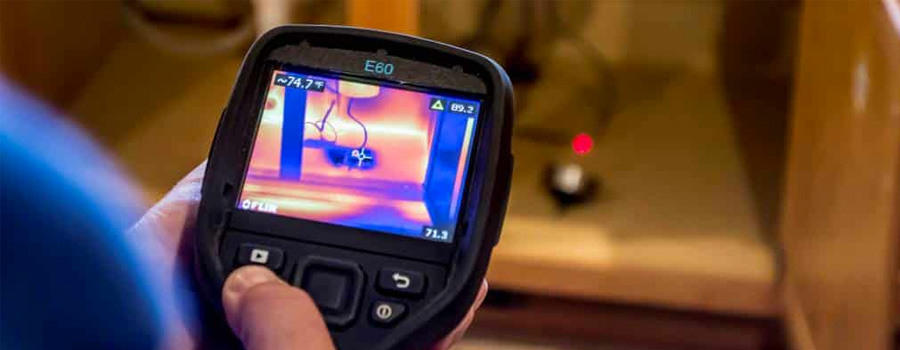
Plumbers use specially designed equipment called thermal imaging cameras that can detect water leaks by reading the fluctuations in the electromagnetic spectrum in the infrared range. These devices can interpret wavelengths imperceptible to the human eye and can read past through layers that cover your plumbing system.

This way, they don’t have to drill holes on your wall or crack your floors open just to see where the leak is coming from.

How does thermal imaging leak detection work?

As we’ve briefly covered above, water leak detection through thermal imaging uses a special camera. These cameras record light as heat and can show this on a visual display screen. They catch the infrared energy and identify small differences in temperature on the surface of different materials. By doing so, they can highlight the warmer and the colder surface areas giving plumbers an idea of where a particular leak is located.

Recent innovations in thermal scanning allow the heat sensed by a thermal imaging camera to be measured and quantified which makes for a more precise way of evaluating the picture displayed by the camera.

That said, plumbers look for moisture patterns to help them identify certain changes or anomalies in your house — leak-wise that is. They would check the walls, the ceiling, and other places where water pipes may be located. They may look for irregular shapes that indicate water and moisture formation hidden behind the concrete or wooden layers in your home.

Without thermal imaging leak detection, finding where the leak is can be difficult as some of the signs are subtle and can be easy to miss.

Reasons for thermal imaging leak detection

Don’t know when to call for a plumber who can detect water leaks using thermal imaging? Here are a few reasons you should consider calling one.

High water bills

Well, unexplained high water bills to be exact. If you don’t own a pool and get a bill that says you’ve consumed as much, you might need to contact a professional leak detector who can help you using thermal imaging.

Chances are, there’s a leak in your property somewhere and it’s causing you to lose water, and you’re being charged for it. Contact a professional so they can assess your property for you.

Peeling paper or paint

This happens on leaks that are located on the walls of your home. Because of the presence of water and moisture, the paint or the wallpaper will dilapidate. The affected portion of the wall will also feel moist and will have a different temperature compared to other portions of the wall.

In this event, a thermal scanner will pick up the changes in temperature. Your leak detection specialist can check a more detailed reading and can take the necessary actions depending on the situation.

Presence of mold and mildew

Because of constant exposure to moisture, mold and mildew can develop on your walls and your floors. If you find a patch of mold or mildew on your home despite seeing no visible causes for it to grow, it’s best to contact a professional.

Don’t risk your family’s health and seek the help of a plumber immediately.

Benefits of leak detection through thermal imaging

  • Can detect moisture in your ceiling, flat roof, walls, and floors
  • A non-destructive leak detection method
  • It creates minimum disruption and causes no damage to your property
  • Fast and accurate leak detection reading

Conclusion

Knowing how thermal leak detection works can help you understand its benefits and gives you an idea of when you should seek the assistance of a leak detector specialist.

If you suspect that you have a leak in your property but are unable to put a finger to it, calling a thermal imaging leak detection company can be the best decision.

14
Oct
2020

You may not always be alerted when a pipe springs a leak. That’s the thing about hidden water leaks: they’re often concealed in the walls or under the floor. Water slowly seeps from a worn join, through a hairline crack in a pipe, or when a tree root interferes with reticulation.

Catching a leak early will drastically reduce the damage (structural and financial) that a leak can do in your home. So, it pays to keep an eye – and an ear – out for these common clues. Then you can take immediate action by calling a Melbourne leak detection specialist to diagnose and deal with the problem.

Signs you may have a water leak inside your home or office can include:

  1. Spiking water bills

An unusually high water bill, assuming your usage hasn’t changed, is one warning sign most Australians are familiar with. In fact, this is the most common catalyst for a call to our Melbourne leak detection team.

Firstly, double-check the meter reading to make sure it wasn’t a calculation error. Then go around the house and see if you notice any of the signs below. At the same time, call our leak detection hotline on 1800 532 533 for fast, affordable and fully-equipped help straight to your home.

  1. Damp spots & visible mould

Identifying damp and developing mould is a truly multisensory experience. Some signs are more subtle than others, but once you notice the insidious mould developing, you can’t miss it:

  • Musty smell in certain rooms/areas
  • Dark patches on walls and ceilings
  • Paint starts to bubble and look spongy

Mould remover will deal with the symptom, but not the hidden water leak causing it. For that, you need to enlist a professional – sooner rather than later.

  1. Runaway water meter

It’s your turn to become a leak detective. If you suspect a leak, one way to confirm your suspicion is to watch the water meter with every tap and appliance turned off.

  • Go through your house to close every tap
  • Check for drips, loose handles or running toilets
  • Disconnect hoses and turn off plumbing to appliances
  • Once everything is off, watch your water meter

Are the numbers still ticking over? You may have a hidden leak draining water into your garden, walls, ceiling or under the floor.

  1. Wet patches on the lawn

Damaged reticulation piping is hard to spot because it’s easy to assume the lawn is wet from dew or rain. But keep an eye on those wet patches of grass to see if they dry up. If not, or if puddles start to appear in other places (including inside) then you are likely dealing with an underground water leak.

Thankfully, our leak detection team uses the latest technology to locate and diagnose leaks, even deep underground in homes and commercial buildings. Find out how we do it.

  1. Running water sound

Running water is a peaceful sound – until it’s in your home. With the taps (and TV) turned off, listen for the sound of running water. Try to follow the sound until you locate the room or area where you think a pipe might be leaking.

There’s another side to the sound as well: if you can hear running water with the tap on, but the pressure is low, then you are likely listening to water drain out through a concealed leak.

In all the above scenarios, the solution is the same. Contact Austest Pipeline Solutions, Melbourne’s leak detection experts with a team of experienced, licenced, and well-tooled plumbers ready to attend your home. We’ll help you locate and repair water leaks with an early intervention approach and non-destructive pipe repair methods.